Thursday, 21 July 2016

Core Genomics is going cor-porate (sort of)

I've just had my five year anniversary of starting the Core Genomics blog! Those five years have whizzed by and NGS technologies have surpassed almost anything I dreamed would have been possible when I started using them in 2007. My blog has also grown beyond anything I dreamed possible and the feedback I've had has been a real motivating factor in keeping up with the writing. It also stimulated my move onto Twitter and I now have multiple accounts: @CIGenomics (me), @CRUKgenomecore (my lab) and @RNA_seq, @Exome_seq (PubMed Twitter bots).

The blog is still running on the Google Blogger site I set up back in 2011 and I feel ready for a change. This will allow me to do a few things I've wanted to do for a while and over the next few months I'll be migrating core-genomics to a new WordPress site: Enseqlopedia.com. 


Saturday, 16 July 2016

Whole genome amplification improved

A new genome amplification technology from Expedeon/Sygnis: TruePrime looks like it might work great for single-cell and low-input anlyses - particularly copy number. TruePrimer is a primer-free multiple displacement amplification technology. It uses the well established phi29 DNA polymerase and a new TthPrimPol primase, which eliminates the need to use random primers and therefore avoids their inherent amplification bias. The senior author on the TthPrimPol primase paper, Prof Luis Blanco, is leading the TruePrime research team.


Thursday, 14 July 2016

How much time is lost formatting references?

I just completed a grant application and one of the steps required me to list my recent papers in a specific format. This was an electronic submission and I’m sure it could be made much simpler, possibly by working off the DOI or PubMed ID? But this got me thinking about the pain of reformatting references and the reasons we have so many formats in the first place. It took me ten minutes to get references in the required format, and I've spent much longer in the past - all wasted time in a day that is already too full!

Saturday, 2 July 2016

Comparison of DNA library prep kits by the Sanger Institute

A recent paper from Mike Quail's group at the Sanger Institute compares 9 different library prep kits for WGS. In Quantitation of next generation sequencing library preparation protocol efficiencies using droplet digital PCR assays - a systematic comparison of DNA library preparation kits for Illumina sequencing, the authors used a digital PCR (ddPCR) assay to look at the efficiency of ligation and post-ligation steps. They show that even though final library yield can be high, this can mask poor adapter ligation efficiency - ultimately leading to lower diversity libraries.

In the paper they state that PCR-free protocols offer obvious benefits in not introducing amplification biases or PCR errors that are impossible to distinguish from true SNVs. They also discuss how the emergence of greatly simplified protocols that merge library prep steps can significantly improve the workflow as well as the chemical efficiency of those merged steps. As a satisfied user of the Rubicon Genomics library prep technology (e.g. for ctDNA exomes) I'd like to have seen this included in the comparison*. In a 2014 post I listed almost 30 different providers.


Hidden ligation inefficiency: The analysis of ligation efficiency by the authors sheds light on an issue that has been discussed by many NGS users - that of whether library yield is an important QC or not? Essentially yield is a measure of how much library a kit can generate from a particular sample, but it is not a measure of how "good" that library is. Only analysis of final library diversity can really act as a sensible QC.

The authors saw that kits with high adapter ligation efficiency gave similar yields when compared to kits with low adapter ligation efficiency (fig 4 reproduced above). They determined that the most likely cause was that the relatively high amount of adapter-ligated DNA going into PCR inhibits the PCR amplification reaction leading to lower than expected yields. For libraries with low adapter ligation efficiency a much lower amount of adapter-ligated DNA would make it into PCR, but because there is no inhibition the PCR amplification reaction leads to higher than expected yields. The best performing kits were Illumina Truseq Nano and PCR free, and KAPA Hyper kit with ligation yields above 30%; and the KAPA HyperPlus was fully efficient.

Control amplicon bias: the PhiX control used had three separate PCR amplicons amplified to assess bias. The kits with the lowest bias at less than 25 % for each fragment size were KAPA HyperPlus and NEBNext. The Illumina TruSeq Nano kit showed different biases when using the "Sanger adaptors" rather than "Illumina adaptors", which the authors suggest highlights that both adapter and fragment sequence play a role in the cause of this bias.

Which kit to choose: The authors took the same decision as most kit comparison papers and shied away from making overt claims about which kit was "best". The did discuss fragmentation and PCR-free as important points to consider.
  • If you have lots of DNA then aim for PCR-free to remove any amplification errors and/or bias.
  • If you don't have a Covaris then newest enzymatic shearing methods e.g. KAPA fragmentase have significantly less bias than previous chemical fragmentation methods.
Ultimately practicability, the overall time and number of steps required to complete a protocol, will be uppermost in many users minds. The fastest protocols were NEBNext Ultra kit, KAPA HyperPlus, and Illumina Truseq DNA PCR-free.

*Disclosure: I am a paid member of Rubicon Genomics' SAB.

Wednesday, 29 June 2016

Measuring translation by ribosomal footprinting on MinION?

Oxford Nanopore should have kits for direct RNA sequencing available later this year, and have several examples of how these might be used on their website. The method presented at London Calling (see OmicsOmics coverage), is primarily for mRNA, but it likely to be adapted for other RNA species in due course.

One of the ideas I've briefly thought about is using the MinION to perform ribosome profiling - a basic method would involve ligating adapters to RNA after cell lysis so Ribosomes  are fixed to mRNAs with cyclohexamide treatment. Fast mode sequencing would identify the 3' end and the transcript, then sequencing speed would be massively ramped up to zip the mRNA through the pore; the bound ribosomes should cause sequencing to stall allowing counting of stall events and therefore the number of ribosomes attached to an mRNA.

Friday, 24 June 2016

I don't want to leave Europe

Brexit sucks...probably. The issue is we don't really know what the vote really means, or even if we'll actually leave the European Union in the next couple of years at all. However one thing cannot be ignored and that is the two-fingered salute to our European colleagues from 52% of the UK voting population that got out of bed on a rainy Thursday.


I am privileged to work in one of the UK's top cancer institutes at the top UK University: the Cancer Research UK Cambridge Institute, a department of the University of Cambridge. The institute, and the University, is an international one with people from all across the globe, many of the staff in my lab have come from outside the UK and they are all great people to work with. I dislike the idea that these people feel insecure about their future because our politicians have done such a crap job on governing the country.

I'd like to keep the international feel so if you're still thinking that working in the UK would be good for you (and your a genomics whiz) then why not check out the job ad for a new Genomics Core Deputy Manager. We're expanding the lab and putting lots of effort into single-cell genomics service (10X Genomics and Fluidigm C1 right now). I'm looking for a senior scientist of any nationality to help lead the team, with NGS experience, and ideas about single-cell genomics.


You can get more information about the lab on our website. You can get more information about the role, and apply on the University of Cambridge website.

Friday, 17 June 2016

Come and work in my lab...

I've just readvertised for someone to my lab as the new Genomics Core Deputy Manager. We're expanding the Genomics core and building single-cell genomics capabilities (we currently have both 10X Genomics and Fluidigm C1). I'm looking for a senior scientist who can help lead the team, who has significant experience of NGS methods and applications; and ideally has an understanding of the challenges single-cell genomics presents. You'll be hands-on helping to define the single-cell genomics services we offer, and build these over the next 12-18 months.


You'll have a real opportunity to make a contribution to the science in our institute and drive single-cell genomics research. The Cancer Research UK Cambridge Institute is a great place to work. It's a department of the University of Cambridge, is one of Europe's top cancer research institutes. We are situated on the Addenbrooke's Biomedical Campus, and are part of both the University of Cambridge School of Clinical Medicine, and the Cambridge Cancer Centre. The Institute focus is high-quality basic and translational cancer research and we have an excellent track record in cancer genomics 1, 2, 3. The majority of data generated by the Genomics Core facility is Next Generation Sequencing, and we support researchers at the Cambridge Institute, as well as nine other University Institutes and Departments within our NGS collaboration.

You can get more information about the lab on our website. You can get more information about the role, and apply on the University of Cambridge website.

Tuesday, 14 June 2016

SPRI alternatives for NGS: survey results

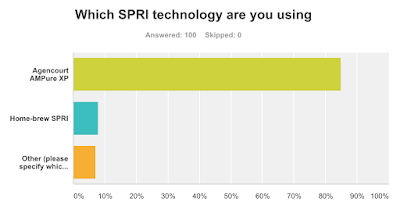
Everyone loves bead cleanups, and it appears that almost everyone (85%) who read my recent post about SPRI alternatives loves Agencourt AMPureXP. I'd asked readers to take a survey asking if they used AMPure XP, a commercial alternative, or a home-brew version - the results are below.

https://www.surveymonkey.co.uk/r/V6LN5VX
Take the survey: https://www.surveymonkey.co.uk/r/V6LN5VX

I was surprised to see more home-brew responses than commercial alternatives, but this could simply reflect the attitudes of people reading CoreGenomics.

Friday, 10 June 2016

CNV, RNA, ChIP and cfDNA sequencing for £10 per sample

Copy-number analysis is a useful tool for many researchers and we use it a lot for analysis of tumour samples. In the past this was done using SNP arrays e.g. Affymetrix SNP6.0 in METABRIC, but today we're generally using low-coverage whole genome sequencing and tools like qDNAseq. I've posted before about our use of low-coverage WGS in our exome pipeline. Most recently we've got groups doing low-coverage WGS on large numbers of samples purely for copy-number analysis.

Low-coverage WGS makes CNV-seq fast and cheap but a recent Genome Research paper suggest some great methodological improvements to push costs down to very low levels:  SMASH, a fragmentation and sequencing method for genomic copy number analysis. 

WGS and SMASH generate highly concordant CNV calls

Thursday, 9 June 2016

Proteomics is starting to rock too...

I don’t usually read Proteomics papers but have been thinking about how we might combine single cell genome and transcriptome sequencing - with Fluidigm’s Helios (CyToF) and have been trying to get more acquainted with Proteomics methods. In doing so I found this excellent paper: Proteomic Biomarker Discovery in 1000 Human Plasma Samples with Mass Spectrometry. The paper is probably a tour-de-force of Proteomics, even if the published results were not stunning, but not being a Proteomecist I’m not sure I’m qualified to say that. It is obvious that the group working on this put a large amount of effort into experimental design ahead of completing the mass-spec work.


Figure from Cominetti et al 2016


Any large project needs to consider design very carefully from considering what factors might need to be controlled for, to deciding what controls to use. The experimental design for the Human proteome paper is illustrated above; they used a controlled-randomised plate layout to remove plate confounding effects for sample origin, gender, age, ethnicity, BMI, blood pressure, glycemic indices, and clinical biochem.

Reducing mass-spec variability with tandem-mass-tags: The key to making the data comparable across what was over 300 mass-spec runs was the use of tandem-mass tags purchased from Thermo Scientific (Rockford, IL, USA), these add specific masses to all proteins in a sample allowing multiplexing of up to 24 samples per run. With a carefully designed experiment it is possible to reduce the impact of run-to-run variability. Much in the same way as we designed projects using multi-sample microarrays, the experimental groups are balanced across mass-spec runs. I’ve learnt a lot more about tandem-mass tagging in Proteomics over the last 18 months after hearing about the tech in an internal seminar. It seems that this approach is going to allow Proteomics researchers to take advantage of the statistical tools developed for gene expression array analysis. The group used a pair of control samples in each run further reducing the impact of technical variability. 304 TMT 6-plex mass-spec runs were performed, with each 6-plex containing two standards, and 4 samples. 1000 patient plasma samples were processed in 19x 96-well plates over a period of just 15 weeks. All sample handling was tracked, although they did not describe their tracking and whether they used a LIMs or not. The paper is a great example of careful experimental design and I thought was one well worth sharing outside the Proteomics community.

Between 150-200 proteins were identified and the authors argue strongly that this was only possible because f the use of TMTs. Label-free mass-spec approaches would have introduced more variability and taken significantly longer (38 weeks by their estimation). However after crunching the numbers only two proteins in Human Plasma had significant correlation with BMI. Both were shown to be associated with obesity.

NGS experimental design: We're lucky to have such a large number of sample barcodes available for NGS experiments. We can usually fit the whole experiment into one library prep plate and a single sequencing pool and remove almost all the confounding technical issues. However this does not mean we should skip careful design of NGS experiments. Taking a little time to discuss the major question(s) being asked, the samples available and the methods we'll use in both wet and dry labs is time very well spent.