Showing posts with label Next-generation sequencing. Show all posts

Friday, 21 October 2016

Does the world have too many HiSeq X Tens?

Illumina stock dropped 25% after a hammering by the stock market with their recent announcements that Q3 revenues would be 3.4% lower than expected at just $607 million. This makes Illumina a much more attractive acquisition (although I doubt this summers rumours of a Thermo bid had any substance), and also makes a lot of people ask the question "why?"

The reasons given for the shortfall were "a larger than anticipated year-over-year decline in high-throughput sequencing instruments" i.e. Illumina sold fewer sequencers than it expected to. It is difficult to turn these revenue figures and statements into the number of HiSeq 2500's, 4000's or X's that Illumina missed it's internal forecasts by, but according to Francis de Souza Illumina "closed one less X deal than anticipated" - although he did not say if this was an X5, X10 or X30! Perhaps more telling was that de Souza was quoted saying that "[Illumina was not counting on a continuing increase in new sequencer sales]"...so is the market full to bursting?


Monday, 17 October 2016

SIRVs: RNA-seq controls from @Lexogen

This article was commissioned by Lexogen GmbH.

My lab has been performing RNA-seq for many years, and is currently building new services around single-cell RNA-seq. Fluidigm’s C1, academic efforts such as Drop-seq and inDrop, and commercial platforms from 10X Genomics, Dolomite Bio, Wafergen, Illumina/BioRad, RainDance and others makes establishing the technology in your lab relatively simple. However the data being generated can be difficult to analyse and so we’ve been looking carefully at the controls we use, or should be using, for single-cell, and standard, RNA-seq experiments. The three platforms I’m considering are the Lexogen SIRVs (Spike-In RNA Variants), or SEQUINs, or ERCC 2.0 (External RNA Controls Consortium) controls. All are based on synthetically produced RNAs that aim to mimic complexities of the transcriptome: Lexogen’s SIRVs are the only controls that are currently available commercially; ERCC 2.0 is a developing standard (Lexogen is one of the groups contributing to the discussion), and SEQUINs for RNA and DNA were only recently published in Nature Methods.

You can win a free lane of HiSeq 2500 sequencing of your own RNA-seq libraries (with SIRVs of course) by applying for the Lexogen Research Award


Lexogen’s SIRVs are probably the most complex controls available on the market today as they are designed to assess alternative splicing, alternative transcription start and end sites, overlapping genes, and antisense transcription. They consist of seven artificial genes in-vitro transcribed as multiple (6-18) isoforms to generate a total of 69 transcripts. Each has a 5’triphosphate and a 30nt poly(A)-tail, enabling both mRNA-Seq and TotalRNA-seq methods. Transcripts vary from 191 to 2528nt long and have variable (30-50%) GC-content.


Want to know more: Lexogen are hosting a webinar to describe SIRVs in more detail on October 19th: Controlling RNA-seq experiments using spike-in RNA variants. They have also uploaded a manuscript to BioRxiv that describes the evaluation of SIRVs and provides links to the underlying RNA-Seq data. As a Bioinformatician you might want to download this data set and evaluate the SIRV reads yourself. Or read about how SIRVs are being used in single-cell RNA seq in the latest paper from Sarah Teichmann’s group at EBI/Sanger.


Before diving into a more in-depth description of the Lexogen SIRVs, and how we might be using them in our standard and/or single-cell RNA-seq studies, I thought I’d start with a bit of a historical overview of how RNA controls came about...and that means going back to the days when microarrays were the tool of choice and NGS had yet to be invented!

Friday, 7 October 2016

Index mis-assignment to Illumina's PhiX control

Multiplexing is the default option for most of the work being carried out in my lab, and it is one of the reasons Illumina has been so successful. Rather than the one-sample-per-lane we used to run when a GA1 generated only a few million reads per lane, we can now run a 24 sample RNA-seq experiment in one HiSeq 4000 lane and expect to get back 10-20M reads per sample. For almost anything other than genomes multiplexed sequencing is the norm.

But index sequencing can go wrong, and this can and does happen even before anything gets on the sequencer. We noticed that PhiX has been turning up in demultiplexed sample Fastq. PhiX does not carry a sample index index so something is going wrong! What's happening? Is this a problem for indexing and multiplexing in general on NGS platforms? These were the questions I have recently been digging into after our move from HiSeq 2500 to HiSeq 4000. In this post I'll describe what we've seen with mis-assignment of sample indexes to PhiX. And I'll review some of the literature that clearly pointed out the issue - in particular I'll refer to Jeff Hussmann's PhD thesis from 2015.

The problem of index mis-assignment to PhiX can be safely ignored, or easily fixed (so you could stop reading now). But understanding it has made me realise that index mis-assignment between samples is an issue we don not know enough about - and that the tools we're using may not be quote up to the job (but I'll not cover this in depth in this post).


Tuesday, 20 September 2016

The future of Illumina according to @chrissyfarr

In yesterdays Fast Company piece Christina Farr (on Twitter) gives a very nice write up of Illumina's history and where they are going with respect to bringing DNA sequencing into the clinic. I really liked the piece and wanted to share my thoughts after reading it with Core-Genomics readers.


Friday, 16 September 2016

Reporting on Fluidigm's single-cell user meeting at the Sanger Institute

The Genomics community is pushing ahead fast on single-cell analysis methods as these are revolutionising how we approach biological questions. Unfortunately my registration went in too late for the meeting running at the Sanger Institute this week (Follow #SCG16 on Twitter), but the Fluidigm pre-meeting was a great opportunity to hear what people are doing with their tech. And it should be a great opportunity to pick other users brains about their challenges with all single-cell methods.


Imaging mass-cytometry: the most exciting thing to happen in 'omics?

Mark Unger (Fluidigm VP of R&D) started the meeting off by asking the audience to consider the two axes of single-cell analysis: 1) Number of cells being analysed, 2) what questions can you ask of those cells (mRNA-seq is only one assay) - proteomics, epigenetics, SNPs, CNVs, etc.

Right now Fluidigm has the highest number of applications that can be run on single-cells with multiple Fluidigm and/or user developed protocols on the Fludigm Open App website; 10X Genomics only have single-cell 3' mRNA-seq right now, as do BioRad/Illumina and Drop-seq. But I am confident other providers will expand into non 3'mRNA assays...I'd go further and say that if they don't they'll find it hard to get traction as users are likely require a platform that can do more than one thing.

Wednesday, 14 September 2016

10X Genomics publications

Anyone that's been reading Core-Genomics will have seen my interest in the technology from 10X Genomics. I've been watching and waiting for publications to come out to get a better understanding of how people are using the technology and thought you might like my current list of articles: many of these are on the BioRxiv and should be available in a reputable journal if you're reading this in 2017 or later!

The number of 10X Genomics publications is going to grow rapidly; and this list will only be updated sporadically!


Friday, 9 September 2016

10X Genomics phasing explained

This post follows on from my previous one explaining the 10X Genomics single-cell mRNA-seq assay. This time round I'm really reviewing the method as described in a paper recently put up on the BioRxiv by 10X's Deanna Church and David JaffeDirect determination of diploid genome sequences. This follows on from the earlier Nat Methods paper which was the first 10X de novo assembly of NA12878, but on the GemCode system. While we are starting some phasing projects on our 10X Chromium box the more significant interest has been on the single cell applications. But if we can combine the two methods (or something else) to get single-cell CNV then 10X are onto a winner!


Thursday, 25 August 2016

Optalysys eco-friendly genomics analysis

The amount of power used in a genome analysis is not something I'd ever thought of until I heard about Optalysys, a company developing optical computing that has the potential to be 90% more energy-efficient and 20X faster than than standard (electronic) compute infrastructure. Read on if you are interested in finding out more, and watch the video below - featuring Prof Heinz Wolff!


Optalysys was originally spun out from the University of Cambridge and the technology needs a lot more explanation that I'll give: briefly they split laser light across liquid crystal grids where each "pixel" can be modulated to encode analogue numerical data in the laser beam, this diffracts forming an interference pattern and a mathematical calculation is performed - all at the speed of light. The beam can be split across many liquid crystals to increase the multiplicity and complexity of mathematical operations performed.

Optalysys and the Earlham Institute in Norwich are collaborating on a project to build hardware/software that will be used for metagenomic analysis. This is a long way from comparing 500 matched tumour and normal genomes in an ICGC project; but if Optalysys can build systems to handle this scale then the huge compute processing tasks might be carried out at a fraction of the current costs and whilst running from a standard mains power supply.

PS: do you remember the Great Egg race as fondly as I do?

Wednesday, 24 August 2016

Upcoming Genomics conferences in the UK

It is almost time for the kick off at Genome Science, probably the best organised academic conference in the UK. It runs from August 30th to September 1st next week and sadly I can't be there (just returned from holidays and too much going on). You can hear from a wide range of speakers in a jam packed agenda. This year it is hosted by the University of Liverpool, and the evening entertainment comes from Beatles Tribute Band “The Cheatles”!

What other conferences are available for Genomics in the UK, and which one should you attend if you too can't make it over to Liverpool? The Wellcome Trust Genome Campus is holding their first Single Cell Genomics conference from September 9th (sold-out I'm afraid). Personally I thought that the London Festival of Genomics was excellent and I've high hopes for the January 2017 meeting. 

Often it is word of mouth that brings a conference to my attention, but there are a couple of resources out there to help.
  • AllSeq maintain a list of conferences.
  • GenomeWeb has a similar list, but it seems less focused than AllSeq.
  • NextGenSeek has a list for 2016, but nothing on the cards for 2017 yet.
  • Nature has an events page (searchable) that lists 50 upcoming NGS conferences.

PS: please do let me know if you've particular recommendations on conferences to attend. And do get in touch with the groups above to list your conference on their sites.

PPS: If you can justify it then the HVP/HUGO Variant Detection Training Course - "Variant Effect Prediction" running from 31st October 2016 is in Heraklion, Crete - a beautiful place to learn!

Thursday, 28 July 2016

10X Genomics single-cell 3'mRNA-seq explained

10X Genomics have been very successful in developing their gel-bead droplet technology for phased genome sequencing and more recently, single-cell 3'mRNA-seq. I've posted about their technology before (at AGBT2016, and March and November 2015) and based most of what I've written on discussion with 10X or from presentations by early access users. Now 10X have a paper up on the BioRxiv: Massively parallel digital transcriptional profiling of single cells. This describes their approach to single-cell 3'mRNA-seq in some detail and describes how you might use their technology in trying to better understand biology and complex tissues.

Monday, 25 July 2016

RNA-seq advice from Illumina

This article was commissioned by Illumina Inc.

The most common NGS method we discuss in our weekly experimental design meeting is RNA-seq. Nearly all projects will use it at some point to delve deeply into hypothesis driven questions, or simply as a tool to go fishing for new biological insights. It is amazing how far a project can progress in just 30 minutes of discussion, methodology, replication, controls, analysis, and all sorts of bias get covered as we try to come up with an optimal design. However many users don't have the luxury of in-house Bioinformatics and/or Genomics core facilities so they have to work out the right sort of experiment to do for themselves. Fortunately people have been hard at work creating resources that can really help and most recently Illumina released an RNA-seq "Buyer’s Guide" with lots of helpful information....including how to keep costs down.


Saturday, 16 July 2016

Whole genome amplification improved

A new genome amplification technology from Expedeon/Sygnis: TruePrime looks like it might work great for single-cell and low-input anlyses - particularly copy number. TruePrimer is a primer-free multiple displacement amplification technology. It uses the well established phi29 DNA polymerase and a new TthPrimPol primase, which eliminates the need to use random primers and therefore avoids their inherent amplification bias. The senior author on the TthPrimPol primase paper, Prof Luis Blanco, is leading the TruePrime research team.


Saturday, 2 July 2016

Comparison of DNA library prep kits by the Sanger Institute

A recent paper from Mike Quail's group at the Sanger Institute compares 9 different library prep kits for WGS. In Quantitation of next generation sequencing library preparation protocol efficiencies using droplet digital PCR assays - a systematic comparison of DNA library preparation kits for Illumina sequencing, the authors used a digital PCR (ddPCR) assay to look at the efficiency of ligation and post-ligation steps. They show that even though final library yield can be high, this can mask poor adapter ligation efficiency - ultimately leading to lower diversity libraries.

In the paper they state that PCR-free protocols offer obvious benefits in not introducing amplification biases or PCR errors that are impossible to distinguish from true SNVs. They also discuss how the emergence of greatly simplified protocols that merge library prep steps can significantly improve the workflow as well as the chemical efficiency of those merged steps. As a satisfied user of the Rubicon Genomics library prep technology (e.g. for ctDNA exomes) I'd like to have seen this included in the comparison*. In a 2014 post I listed almost 30 different providers.


Hidden ligation inefficiency: The analysis of ligation efficiency by the authors sheds light on an issue that has been discussed by many NGS users - that of whether library yield is an important QC or not? Essentially yield is a measure of how much library a kit can generate from a particular sample, but it is not a measure of how "good" that library is. Only analysis of final library diversity can really act as a sensible QC.

The authors saw that kits with high adapter ligation efficiency gave similar yields when compared to kits with low adapter ligation efficiency (fig 4 reproduced above). They determined that the most likely cause was that the relatively high amount of adapter-ligated DNA going into PCR inhibits the PCR amplification reaction leading to lower than expected yields. For libraries with low adapter ligation efficiency a much lower amount of adapter-ligated DNA would make it into PCR, but because there is no inhibition the PCR amplification reaction leads to higher than expected yields. The best performing kits were Illumina Truseq Nano and PCR free, and KAPA Hyper kit with ligation yields above 30%; and the KAPA HyperPlus was fully efficient.

Control amplicon bias: the PhiX control used had three separate PCR amplicons amplified to assess bias. The kits with the lowest bias at less than 25 % for each fragment size were KAPA HyperPlus and NEBNext. The Illumina TruSeq Nano kit showed different biases when using the "Sanger adaptors" rather than "Illumina adaptors", which the authors suggest highlights that both adapter and fragment sequence play a role in the cause of this bias.

Which kit to choose: The authors took the same decision as most kit comparison papers and shied away from making overt claims about which kit was "best". The did discuss fragmentation and PCR-free as important points to consider.
  • If you have lots of DNA then aim for PCR-free to remove any amplification errors and/or bias.
  • If you don't have a Covaris then newest enzymatic shearing methods e.g. KAPA fragmentase have significantly less bias than previous chemical fragmentation methods.
Ultimately practicability, the overall time and number of steps required to complete a protocol, will be uppermost in many users minds. The fastest protocols were NEBNext Ultra kit, KAPA HyperPlus, and Illumina Truseq DNA PCR-free.

*Disclosure: I am a paid member of Rubicon Genomics' SAB.

Wednesday, 29 June 2016

Measuring translation by ribosomal footprinting on MinION?

Oxford Nanopore should have kits for direct RNA sequencing available later this year, and have several examples of how these might be used on their website. The method presented at London Calling (see OmicsOmics coverage), is primarily for mRNA, but it likely to be adapted for other RNA species in due course.

One of the ideas I've briefly thought about is using the MinION to perform ribosome profiling - a basic method would involve ligating adapters to RNA after cell lysis so Ribosomes  are fixed to mRNAs with cyclohexamide treatment. Fast mode sequencing would identify the 3' end and the transcript, then sequencing speed would be massively ramped up to zip the mRNA through the pore; the bound ribosomes should cause sequencing to stall allowing counting of stall events and therefore the number of ribosomes attached to an mRNA.

Tuesday, 14 June 2016

SPRI alternatives for NGS: survey results

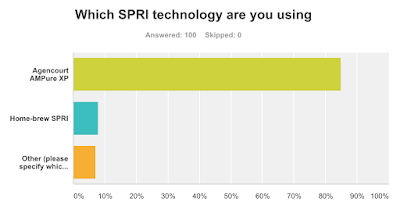
Everyone loves bead cleanups, and it appears that almost everyone (85%) who read my recent post about SPRI alternatives loves Agencourt AMPureXP. I'd asked readers to take a survey asking if they used AMPure XP, a commercial alternative, or a home-brew version - the results are below.

https://www.surveymonkey.co.uk/r/V6LN5VX
Take the survey: https://www.surveymonkey.co.uk/r/V6LN5VX

I was surprised to see more home-brew responses than commercial alternatives, but this could simply reflect the attitudes of people reading CoreGenomics.

Friday, 10 June 2016

CNV, RNA, ChIP and cfDNA sequencing for £10 per sample

Copy-number analysis is a useful tool for many researchers and we use it a lot for analysis of tumour samples. In the past this was done using SNP arrays e.g. Affymetrix SNP6.0 in METABRIC, but today we're generally using low-coverage whole genome sequencing and tools like qDNAseq. I've posted before about our use of low-coverage WGS in our exome pipeline. Most recently we've got groups doing low-coverage WGS on large numbers of samples purely for copy-number analysis.

Low-coverage WGS makes CNV-seq fast and cheap but a recent Genome Research paper suggest some great methodological improvements to push costs down to very low levels:  SMASH, a fragmentation and sequencing method for genomic copy number analysis

WGS and SMASH generate highly concordant CNV calls

Thursday, 19 May 2016

Happy 10th birthday NGS!

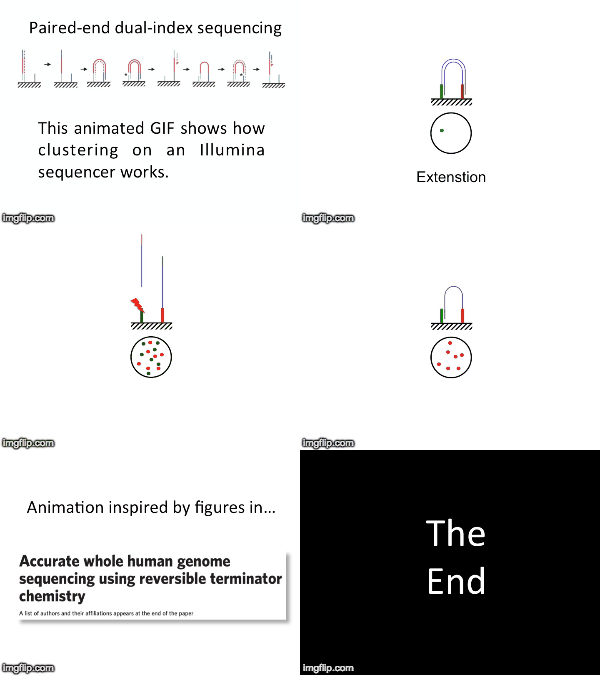
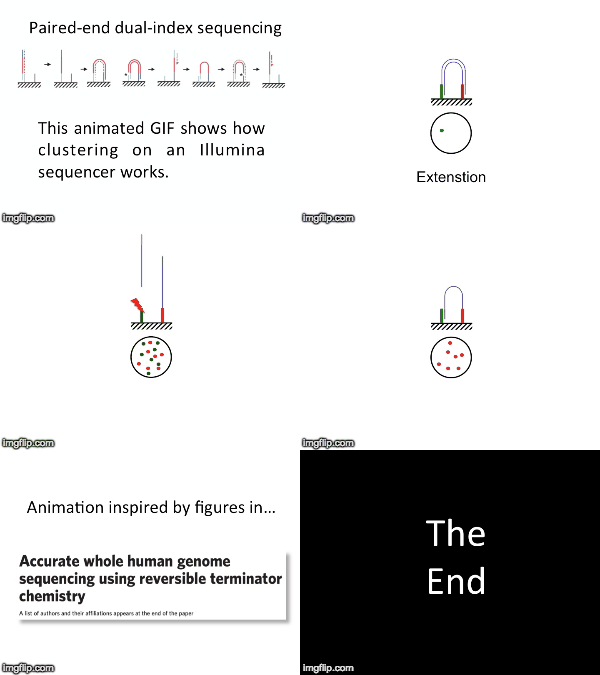
NGS is 10...according to the latest Nature Reviews Genetics: Coming of age: ten years of next-generation sequencing technologies. Just by chance I was asked to give a talk to explain how Illumina sequencing works in a technology seminar series being delivered by the Core Heads at the CRUK Cambridge institute, and as part of that I uploaded a slide-deck and created some animations for Twitter to explain how clustering works...I hope you like it.

Illumina paired-end dual-index clustering and sequencing
and here is a "slow-mo" version for people who could not keep up with the frame-rate!

Wednesday, 16 April 2014

More of a fizz than a bang: HiSeq 1TB is now available

Updated after a conversation with Illumina: it turns out pricing for V4 was released early in an email from Christian Henry (Illumina SVP & COO) on Feb 25th. Single end pricing is now compared below and list pricing for all reagents has been used in the comparisons of V3 to V4.

Illumina launched the much anticipated v4 kits for 1TB (PE125bp) sequencing on HiSeq 2500 today: we're about to jump from 600GB in ten days to 1Tb in six - awesome and awe inspiring! We are also not far away from 1M reads costing less than 1$!

Monday, 7 April 2014

Making ChIP-seq a little more robust

I had a fun time at Jason Carroll's group retreat in sunny Cromer a few weeks ago. I was invited to present some work we'd been doing on using Thruplex for ChIP-seq library prep and there was a lot of great science being discussed.

Thursday, 27 March 2014

Illumina vs LifeTechnologies: the latest instrument comparison

A recent PLoS One paper is perhaps the latest battle in the Illumina vs LifeTech war. The latest paper in PLOS ONE presents a comparison of MiSeq and Proton PI sequencing to detect chromosome abnormalities in self-aborted foetuses: Chen et al: Performance Comparison between Rapid Sequencing Platforms for Ultra-Low Coverage Sequencing Strategy .