Tuesday, 31 May 2016

London Calling: nanopores updated

I did not arrive at London Calling until late on Thursday afternoon but what an excellent start I was given: Clive Brown’s update - where ONT are today, and what’s coming tomorrow! The Thursday afternoon, evening and Friday sessions created a palpable buzz in the attendees. It is easy to get carried away with predictions about how soon ONT will become actual competition for Illumina, but it is not clear that this is ONT's main goal. More exciting is the push into uncharted territory, bringing sequencing to individuals and taking it to Mars. I'm excited; but my core facility manager head says, "hold on, you're not getting rid of those HiSeq's just yet"!


Monday, 30 May 2016

Oxford Nanopore's Direct RNA-seq - the killer app for bacterial genomics?

I'll finish my write up of the ONT London Calling event after the bank-holiday weekend but I wanted to get this post out as I think we came up with a killer app for MinION, or even SmidgION on your iPhone: direct RNA-seq from bacterial 16S rRNA. This was an idea I proposed in response to an answer about what one of the speakers was doing with Nanopores (they were working on 16S amplicons). In the ensuing discussion we decided that sequencing the ribosomal RNA directly (see Clive's announcement below) would allow interrogation of phylogenetic relationships and environmental diversity, quickly, and with close to zero bias from sample extraction and library prep.


Monday, 23 May 2016

Increased read duplication on patterned flowcells- understanding the impact of Exclusion Amplification

Next-generation sequencing is fantastic technology and its use has revolutionised our understanding of biology, but it is not perfect, multiple issues occur in every lab from sample extraction through to the actual sequencing. Not all of these are well enough understood to be safely ignored and in this post I'm going to talk about one that I'm trying to better understand right now - duplication of sequences in datasets, and in particular Exclusion Amplicifation duplication on HiSeq 4000.


Sources of read duplicates in Illumina data - courtesy Illumina 2016

Thursday, 19 May 2016

Happy 10th birthday NGS!

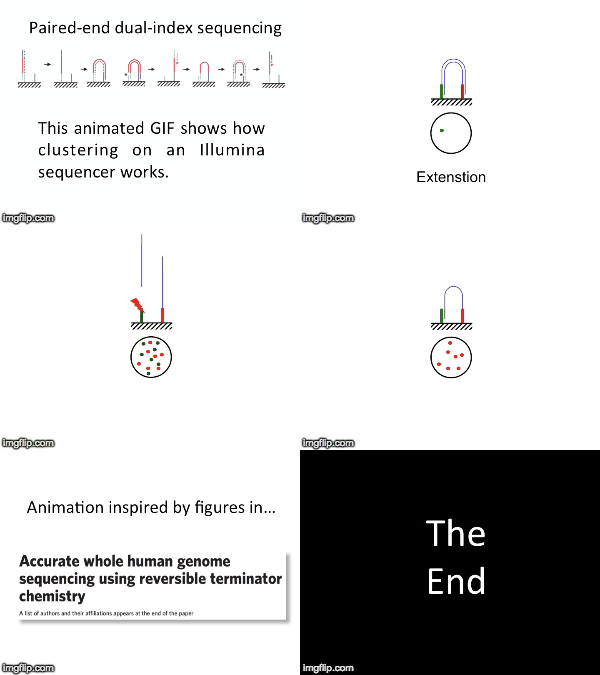
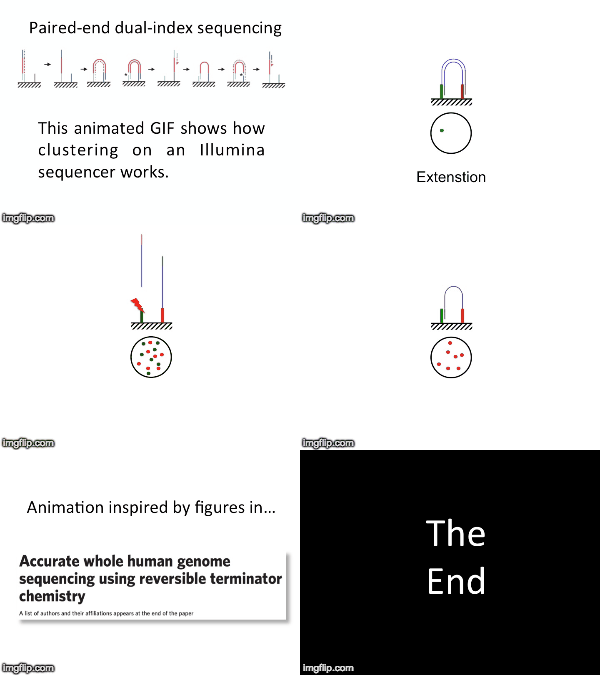
NGS is 10...according to the latest Nature Reviews Genetics: Coming of age: ten years of next-generation sequencing technologies. Just by chance I was asked to give a talk to explain how Illumina sequencing works in a technology seminar series being delivered by the Core Heads at the CRUK Cambridge institute, and as part of that I uploaded a slide-deck and created some animations for Twitter to explain how clustering works...I hope you like it.

Illumina paired-end dual-index clustering and sequencing
and here is a "slow-mo" version for people who could not keep up with the frame-rate!

Wednesday, 18 May 2016

How will Foundations recent patent announcment affect the cancer testing environment

Foundation Medicine were yestoday granted US Patent 9,340,830 "Optimization of Multigene Analysis of Tumor Samples". This is likely to stir up the can of worms that is tumour testing by NGS and is another patent in a complex landscape. The claims basically cover WGS library prep, exome sequencing, alignment and variant calling. It covers all sorts of mutation calling including SNVs at low freq (5%) and mid-freq (10%) or above, SNPs to assess CNV & LOH, fusions and other structural variants, as well as pharmacogenomic SNPs. It also includes in the test a DNA fingerprint.


Michael Pellini, Foundation's CEO appears to be using some very positive language in describing the award of this patent, he said "we do not intend to block the use of methods covered by the patent in patient testing that may be offered by others". But how much of the patent claim is truly novel and might stand up in court remains to be seen. The basic idea of exome sequencing patients is old hat and Foundation were certainly not the first people to be doing this. The SNP ID of patients is an idea even I'd proposed over four years ago (here & here). But if Foundation's patent makes it harder for others to clamp down on competition that can only be a good thing.

Monday, 16 May 2016

How many genomes can the world sequence per year on X Ten?

Illumina's X Ten was a major announcement. It arguably delivered the "$1000 genome", kickstarted national population genomics as a science, and delivered the final blow to Complete Genomics. It is debatable as to whether Illumina needed to release X Ten at $1000, or with such huge capacity; and it is unclear what the X Ten economics really look like for customers or Illumina themselves, but the world can now sequence an unprecedented number of genomes: about 576,000 per year!


Where are all the X Tens: There look to be about 320 X Ten instruments, I searched online and at AllSeq (great) and Genohub (not so great). Installations include - Baylor College of Medicine (10), Broad Institute (14), CEN4GEN (5), Centre National de GeŽnotypage (5), Core Genetics (?), DKFZ (10), Garvan Institute of Medical Research (10), GENEWIZ (10), Genome Quebec (5), GRAIL (?), HudsonAlpha (10), Human Longevity Inc (20), Macrogen (10), McDonnell Genome Institute (10), New York Genome Center (10), Novogene (10), SciLifeLab (10), Sidra Medical and Research Center (10), SNP&SEQ (?), Theragen Etex Bio (10), Wellcome Trust Sanger Institute (10), WuXi AppTec (10), Genomics England (Illumina) (30), Scottish Genomes Partnership (15), DeCode.

How genomes are actually being sequenced: While each X Ten box can generate one thousand eight hundred $1000 genomes per year it is unclear how heavily they being used. There are very few reports of X Tens being used at capacity and even 80% capacity seems to be optimistic so a large number of those boxes may be sitting idle. The reasons for this are likely to vary from lab to lab but three main factors need to be considered:
  1. Sample collection: getting enough patients recruited
  2. The cost of sequencing: finding the cash
  3. Analysis and interpretation: hiring enough Bioinformaticians
We're just about to send off our first X Ten project for 1000 genomes...tough to do on two HiSeq 4000's!

Friday, 6 May 2016

BaseSpace updated: no more "free" bioinformatics

I've been a big fan of Illumina's BaseSpace since it was launched in late 2011. It was the first truly simple to access and free to use cloud-based analysis infrastructure for NGS data. I've used it a lot - primarily for run monitoring, but also for RNA-seq and Exome QC analysis using the BaseSpace Apps. But the free-for-all analysis Smörgåsbord is ending, and users will be looking carefully at the costs to determine if BaseSpace offers real value when compared to their internal infrastructure.


Tuesday, 3 May 2016

How many reads to sequence a genome?

Last year I posted about the Lander-Waterman equation used to calculate the number of reads needed to sequence a sample. I explained that this general equation (C = LN/G) can be rearranged to allow you to compute the number of reads (N) to sequence a genome of known size (G) with specific coverage (C) and using reads of a specified length (L). Today I finally finished my Calculoid NGS reads calculator to make it easier to access..feel free to use and reuse as you see fit.


Friday, 29 April 2016

SPRI alternatives for NGS

SPRI beads, generally in the form of AMPureXP beads, are almost ubiquitous in genomics applications such as library prep for NGS. The most popular thing I've ever written was a post on this blog four years ago: "How do SPRI beads work?" with almost 100,000 readers - people obviously want to understand how this wonderful technology can be used. They'd also like it to be cheaper as the Agencourt AMPureXP product (now Beckman) is somewhat expensive - so I've taken a look at some of the alternatives on the market, including DIY SPRI!

Thursday, 28 April 2016

The junior doctors strike...as explained to me

I met two dads last night, one a junior doctor picking his daughter up from the same Karate class my son; the other, a consultant, at the pub after a long day (covering for junior doctors). Both of them spoke about the junior doctors strike and some of what they said is mind boggling. How have we come to such a sorry state in the NHS? Are doctors simply overpaid since contracts were changed by Blair and co? Are the managers of the NHS just after balancing a budget with no thought for the impact their decisions might have on other departments? And does Jeremy Hunt deserve to have his name used as Cockney rhyming slang?

This is how the situation was explained to me:
  • A BMJ paper in September 2015 showed that patients are 10-15% more likely to die if they are admitted on a weekend. [This work has been criticised as flawed due to the complexities of comparing patients admitted on different days - you may actually be sicker at the weekend. But the paper has an errata as it turned out that one of the authors Bruce Keogh (medical director of NHS England) is "a long standing proponent of improving NHS services seven days a week" why the BMJ should have to "have requested that this be included in the authors’ conflict of interest statement" I don't know - seems obvious to include it to me.]
  • Because of this the government in England has decided that NHS services should be available seven days a week.
  • They have proposed a new contract for junior doctors that changes the hourly rate they get after 7pm and at the weekends, and they won't get annual pay increments, instead pay progression will be linked to training.
  • Junior doctors already work weekends.
  • Junior doctors say the new contract will not add new doctors to the system, but it will make them cheaper to pay at the weekend.
  • Both parties cannot come to an agreement so junior doctors have gone on strike.
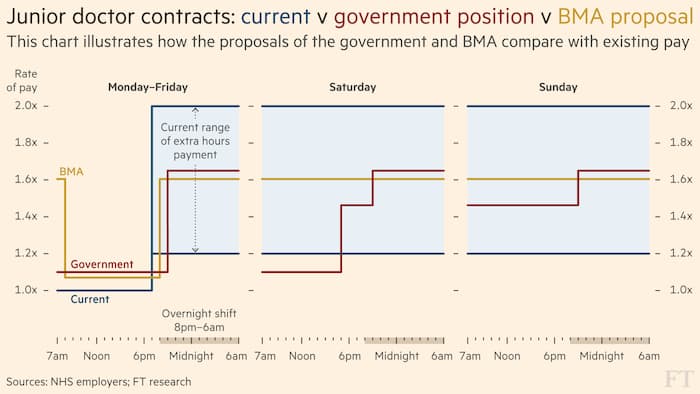
How will pay change: The Financial Times has a nice graphic showing how the current pay structure compares to those proposed by the government or the BMA. And the BBC also have a graphic showing the junior doctors rates for unsocial hours, I used their numbers to try and see how different the positions are and it really did not seem to be worth striking over - I make the BMAs suggestion as cheaper that the governments!?!

From FT.com

The aim appears to be to get more doctors working at weekends, and it should make paying them at weekends cheaper than today so money will be saved. But the consultant I spoke to used a single example to show how much waste is happening in the NHS - and that fixing this would have far more impact than changing junior doctors rates of pay.

An example of NHS waste: The consultant described an elderly patient who needed a mental health referral before discharge, however the person who would do this was on holiday for a week, so the consultant's patient has to stay in hospital. This blocks the bed for 7 days at around £400 per night (that's the equivalent of The Goring in London, or The Waldorf Astoria in New York). If 10 patients are in the same situation then the bill for this persons one weeks holiday comes to £28,000 or equivalent to a junior doctors salary...and most people get six weeks holiday in the NHS.

The NHS does wonderful things for the UK but successive governments have seriously messed it up. My wife recently spent time in Addenbrookes and whilst she received adequate care the communication from doctors and nurses was abysmal, the food can not be described using any positive adjectives, and the accommodations are pretty terrible given the cost of the bed for the night. I'd love to sing the praises of the NHS but it does feel like big changes are needed...but I am not suggesting I can come up with any useful ideas!